


Best Sewing Machines for Quilting Buying Guide
If you’re serious about quilting, you know that not just any sewing machine will do. The best ones come with a generous throat space (look for at least 8.5 inches), a motor that won’t quit, and a dual-feed system or a reliable walking foot. For straight-line speed demons, the Brother PQ1500SL is a classic. If you need a true workhorse, the Juki TL-2010Q is legendary. And for those who want all the bells and whistles, the Janome Memory Craft 6650 delivers with its computerized smarts.
Choosing Your Perfect Quilting Sewing Machine
Walking into a sewing machine shop can feel a little overwhelming. The key is to ignore the noise and focus on what truly matters for a quilter. That’s what we’re here to do—zero in on the features that separate a decent machine from a fantastic one for your projects.
We'll break down the essentials, whether you're piecing tiny, intricate blocks or trying to wrangle a king-sized quilt sandwich through the machine. It’s all about matching the machine’s muscle to your creative vision, no matter if you're just starting out or have been quilting for years.
Top Quilting Machine Picks At a Glance
To give you a starting point, here’s a quick rundown of our top recommendations. This table gets right to the point, showing you what each machine does best and who it’s built for.
| Machine Model | Key Quilting Feature | Throat Space | Best For |
|---|---|---|---|
| Brother PQ1500SL | High-Speed Straight Stitch | 8.6 Inches | Straight-line quilting and piecing |
| Juki TL-2010Q | Industrial-Grade Motor | 8.5 Inches | Power users and free-motion artists |
| Janome Memory Craft 6650 | Built-in Dual Feed System | 10 Inches | All-around quilting and large projects |
| Singer Quantum Stylist 9960 | Extensive Stitch Library | 6.5 Inches | Budget-conscious beginners and decorative work |
Think of this as your shortlist. Each one has a unique strength, so consider what kind of quilting you do most often.
Understanding the Modern Quilting Landscape
Quilting isn't just a niche hobby anymore. The U.S. quilting industry is a massive $4.5 billion market, and that passionate community is always on the lookout for better tools—from high-quality machines to unique fabrics. This demand has pushed manufacturers to innovate, creating machines that blend time-honored precision with modern technology. You can discover more insights about quilting industry trends on mrsquilty.com.
Key Takeaway: A purpose-built quilting machine isn't a luxury; it's a tool designed to handle the specific demands of the craft—managing bulk, ensuring perfectly even stitches through multiple layers, and providing the space needed for creative freedom.
This guide is here to give you the confidence to make a smart decision. When you know what to look for, you can invest in a machine that won’t just meet your needs today but will be a trusted partner as your skills grow. Let’s dive into the features that truly make a difference.
Decoding the Features That Truly Matter for Quilters
When you're picking a sewing machine for quilting, it's easy to get distracted by flashy stitch counts or brand names. But what really separates a good machine from a great one for quilting are the features that directly impact your workflow. Understanding these will help you find a machine that feels less like a tool and more like a partner in your craft.
Let's start with the big one: throat space. You'll also hear this called "harp space." It's simply the distance between the needle and the main body of the machine. This single measurement determines how large a quilt you can comfortably work on without a fight.
Most standard sewing machines have a throat space of around 5-6 inches. That’s perfectly fine for piecing together quilt blocks, but the moment you try to stuff a rolled-up quilt sandwich through that gap, you'll feel the frustration. For anyone serious about quilting, an 8.5-inch throat is really the minimum you should consider. It gives you enough breathing room to manage a decent-sized throw quilt.
Why Space and a Good Feed System are Non-Negotiable
If you dream of making queen or even king-sized quilts, machines with 10 inches or more of throat space are where the magic happens. This isn't just a small upgrade; it completely changes the experience. The extra room drastically cuts down on the physical effort of wrestling with your fabric, leading to smoother quilting and a lot less strain on your back and shoulders.
Next up is how the machine handles fabric. A basic machine uses feed dogs under the fabric to pull it along. But a quilt sandwich—with its top, batting, and backing—is a thick, slippery beast. A standard feed system often lets the layers shift, which is how you end up with frustrating puckers and uneven seams.
This is where specialized feed systems come into play.
- Walking Foot: Think of this as a temporary upgrade. It's a bulky presser foot you attach that has its own set of feed dogs. It grips the top layer of your quilt and moves it in sync with the machine's bottom feed dogs, keeping everything aligned.
- Dual-Feed System: This is the built-in, elegant solution. It’s a mechanism that engages from behind the presser foot to do the same job as a walking foot, but with more power and less fuss.
A dual-feed system is a major selling point on higher-end quilting machines. A good walking foot gets the job done, but the integrated design of a dual-feed system gives you better control and a much more streamlined process for tackling bulky quilts.
The infographic below really puts these key quilting features into perspective.
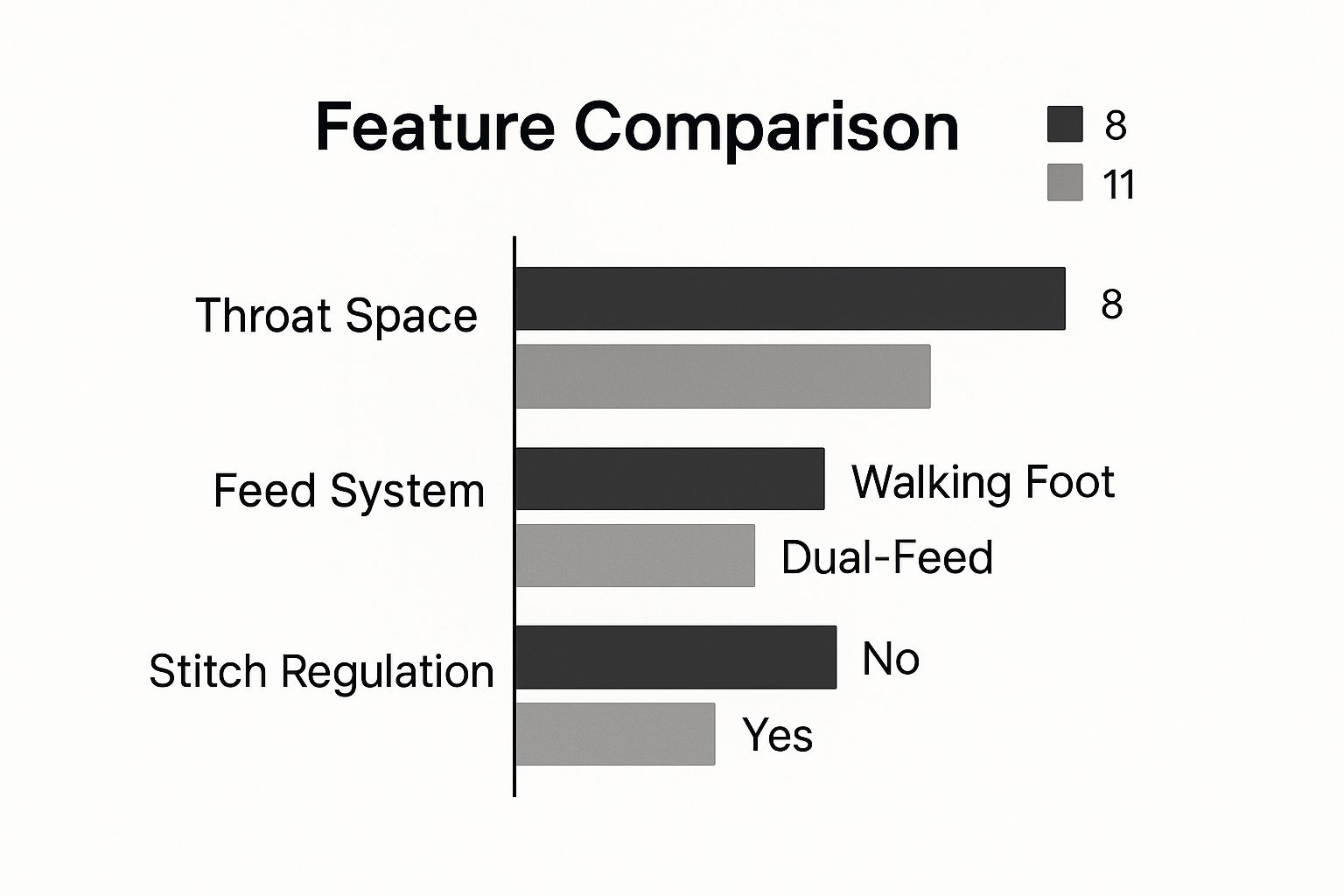
As you can see, moving from standard features to those designed specifically for quilting isn't just an incremental improvement—it opens up a whole new level of capability.
Automation That Helps, Not Hinders
If you're drawn to the artistry of free-motion quilting, stitch regulation is a feature you'll fall in love with. Normally, in free-motion work, you drop the feed dogs and move the fabric yourself. The challenge is keeping your stitches even. A stitch regulator uses sensors to watch how fast you're moving the fabric and tells the machine to speed up or slow down to match. The result? Perfect, consistent stitches every time.
Mastering even stitches manually takes hundreds of hours of practice. Stitch regulation practically eliminates that learning curve, letting you achieve professional-looking results right away.
Beyond the big-ticket items, a handful of smaller features make a huge difference in your day-to-day quilting.
- Needle Up/Down Function: This lets you set the needle to always stop in the down position, anchoring your fabric right where you need it. It’s a lifesaver for pivoting at corners without shifting your work.
- Automatic Thread Cutter: A simple button press snips both the top and bobbin threads. It might sound minor, but it saves an incredible amount of time you'd otherwise spend trimming thread tails.
- Speed Control Slider: This genius little slider lets you cap the machine's top speed. You can floor the foot pedal for control, but the machine will only go as fast as you've set it. It's perfect for precise piecing or navigating complex curves.
Finally, think about your entire quilting setup. An extension table is crucial for supporting the weight of your quilt and preventing it from dragging at the needle. As you compare machines, also think about how they'll fit into your space long-term. Our guide on suitable sewing machines for cabinet installation can help you think through design elements, like a flatbed, that can make your quilting far more ergonomic and enjoyable.
Comparing the Top Sewing Machines for Quilting
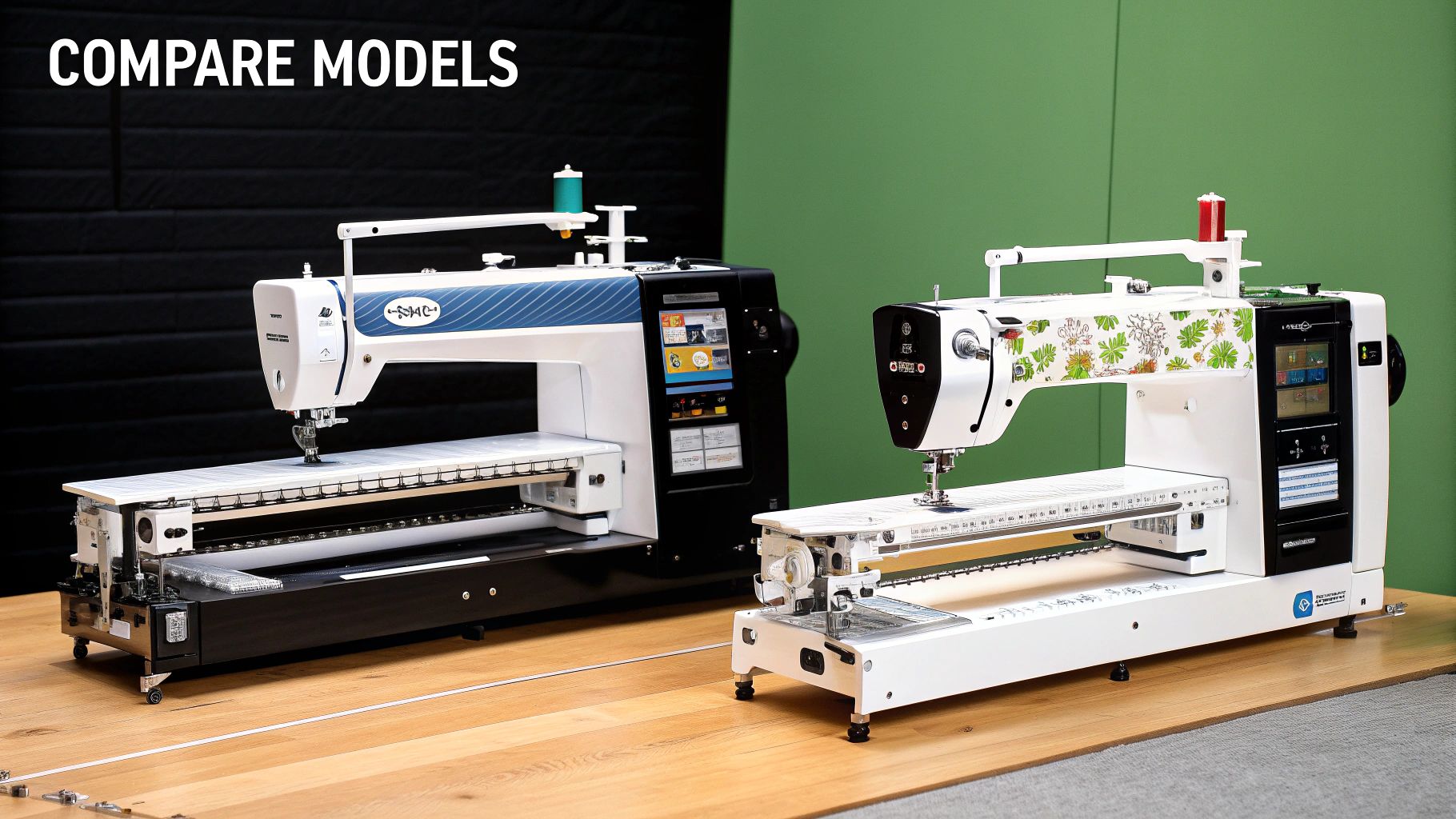
Alright, let's get to the heart of it—a head-to-head comparison of the top quilting machines. Forget just reading a spec sheet. We're going to put these machines into the real-world situations every quilter knows well: wrestling a thick quilt sandwich, guiding delicate free-motion designs, and flying through hours of chain piecing.
My goal here is to help you see how each machine actually feels and performs under pressure. We'll look beyond the obvious, like throat space, and dig into the subtleties of stitch quality, motor strength, and how intuitive the features are when you're deep in a project. This is where a machine’s design truly shows its worth.
The Straight-Stitch Powerhouse vs. The Computerized All-Rounder
First up, we have two machines that represent completely different philosophies: the Brother PQ1500SL and the Janome Memory Craft 6650. Knowing which camp you fall into is the first step toward finding the right machine.
The Brother PQ1500SL is a pure specialist. Think of it as a semi-industrial, mechanical workhorse built for one thing: speed. It blasts through seams at up to 1,500 stitches per minute, making it an absolute dream for chain piecing and straight-line quilting. Its powerful motor doesn't flinch at bulky seams, which is why it's a long-standing favorite for quilters who prioritize raw efficiency.
On the other side of the ring is the Janome Memory Craft 6650, a versatile and feature-packed computerized machine. It's designed to do it all, from hundreds of decorative stitches to practical functions like an automatic thread cutter and a needle up/down button. Its secret weapon is the AcuFeed Flex™ system—a built-in walking foot that gives you incredible control over fabric layers and all but eliminates puckering.
Key Differentiator: The Brother is all about focused, brute-force power for piecing and straight-line work. The Janome is about total control and versatility, equipped with advanced features for piecing, appliqué, and finishing your quilts.
So, who are they for? If you spend 80% of your time piecing tops that you send to a longarmer, the Brother PQ1500SL offers unbeatable performance for the price. But if you want a single machine to handle everything from piecing to free-motion quilting and decorative stitching, the Janome 6650’s comprehensive feature set is hard to beat.
The Free-Motion Artist’s Dilemma
Now, let's bring the Juki TL-2010Q into the mix. This machine is often seen as a direct rival to the Brother PQ1500SL. It’s another high-speed, straight-stitch machine with a similar robust build and powerful motor. However, a few key differences have made it the darling of the free-motion quilting community.
The Juki gives you much better speed control. A simple slider lets you cap the maximum speed, which is a lifesaver when you're learning free-motion and don't want the machine to get away from you. It also has a reputation for being exceptionally smooth when the feed dogs are dropped, giving you a fluid, responsive feel as you guide the fabric.
Many quilters find that while both machines are fantastic, their primary quilting style pushes them one way or the other. If you’re a dedicated piecer, the Brother is a cost-effective beast. But if your heart is set on mastering free-motion quilting on your domestic machine, the Juki’s refined controls give it a noticeable advantage.
The Budget-Friendly Contender
Of course, not everyone has or wants to spend over a thousand dollars on a new machine. That’s where a model like the Singer Quantum Stylist 9960 comes in. It packs an almost unbelievable number of computerized features—like 600 built-in stitches, an automatic thread cutter, and an included extension table—at a price that’s far more accessible.
But, as you’d expect, there are trade-offs. The biggest one for quilters is the small throat space, which measures only about 6.5 inches. This makes quilting anything larger than a lap or baby quilt a real struggle. The motor is also a standard consumer-grade one, so it may protest a bit when quilting through multiple thick layers or dense seams.
For a beginner who is mostly piecing and wants to play with decorative stitches, the Singer 9960 is a fantastic value. It gives you a ton of room to grow and experiment. However, if you already know you want to quilt your own large projects, that limited throat space will become a source of frustration pretty quickly.
Situational Recommendation: If your budget is under $500 and you're just dipping your toes into quilting, the Singer 9960 offers more bang for your buck than almost any other machine. If you're already committed to finishing large quilts at home, saving up for a machine with at least an 8.5-inch throat is a much smarter long-term move.
A Look at the Growing Market
The sheer variety we're seeing in these machines isn't an accident. The global sewing machine industry was valued at roughly USD 4.56 billion and is projected to hit USD 5.53 billion by 2030. Electric machines like these dominate the market, holding a 44.8% share, which shows just how much demand there is for powerful tools that simplify complex hobbies like quilting. This information, highlighted in reports like this one from Grand View Research, explains why manufacturers keep innovating—and that’s great news for us quilters.
Detailed Feature Showdown of Top Quilting Machines
To really nail down the differences, a side-by-side table can cut through the noise. Here’s a look at how our top contenders measure up on the features that matter most to quilters, along with my take on what those specs mean for your day-to-day sewing.
| Feature | Brother PQ1500SL | Juki TL-2010Q | Janome MC6650 | Analysis & Recommendation |
|---|---|---|---|---|
| Throat Space | 8.6 inches | 8.5 inches | 10 inches | The Janome is the clear winner for large quilts. The Brother and Juki offer ample space for most projects. |
| Motor & Speed | Semi-industrial, up to 1,500 SPM | Semi-industrial, up to 1,500 SPM | Strong computerized, up to 1,000 SPM | For raw speed, the Brother and Juki are unmatched. The Janome is plenty fast and offers more controlled power. |
| Feed System | Pin-feed system | Standard drop-feed | AcuFeed Flex™ Dual Feed | The Janome's AcuFeed system is the gold standard for preventing puckering. The Brother's pin-feed is excellent for difficult fabrics. |
| Primary Use Case | High-speed piecing, straight-line quilting | Free-motion quilting, all-purpose power | All-in-one quilting (piecing to finishing) | Your choice depends on your focus. Juki for artistry, Brother for production piecing, and Janome for doing it all. |
| Key Differentiator | Unbeatable speed for the price | Superior free-motion control & feel | Integrated dual feed & stitch versatility | The Juki's variable speed slider is a game-changer for FMQ. The Janome's built-in walking foot and stitch library offer complete creative freedom. |
| Ideal Quilter | The Production Piecer | The Free-Motion Artist | The Versatile Crafter | Match the machine's strength to your passion. Are you building tops, or are you quilting them from start to finish? |
Ultimately, choosing the best sewing machine isn't about finding a single "perfect" model—it's about finding the one that’s perfect for you and the way you create.
- For the Purist: If your happy place is the sound of a powerful motor turning out flawless seams at high speed, the Brother PQ1500SL or the Juki TL-2010Q will feel like coming home. They are focused, powerful, and built like tanks.
- For the Versatile Quilter: If you love every step of the process—from piecing and appliqué to quilting the final sandwich—the Janome Memory Craft 6650 is a complete system that handles each task with precision and grace.
- For the Aspiring Quilter: If you're starting out and want a machine loaded with features that won't break the bank, the Singer Quantum Stylist 9960 is an incredible launchpad for learning and creativity.
Think about your personal quilting goals, your budget, and the space you have. When you align a machine’s strengths with your own ambitions, you'll find a partner that feels like a natural extension of your hands.
Mechanical Versus Computerized Quilting Machines
One of the biggest decisions you'll make when buying a machine is whether to go mechanical or computerized. This isn't just about old-school versus new-tech; it’s about matching the machine’s fundamental design to your personal quilting style. Getting this right is a huge step toward finding a machine you'll love for years.
A mechanical sewing machine is a workhorse, plain and simple. You operate everything with knobs and dials, giving you a very direct, hands-on feel for your stitching. These machines are legendary for their durability and beefy motors that can punch through thick quilt sandwiches without skipping a beat.
For a lot of traditional quilters, a high-end mechanical model is the gold standard. They are absolute masters of the perfect straight stitch—the cornerstone of precise piecing. If your days are filled with piecing traditional blocks and you value simplicity and raw power over bells and whistles, a mechanical machine might just be your most reliable quilting partner.
The Advantages of Computerized Control
On the other hand, computerized sewing machines open up a world of precision, convenience, and creative features that can feel like a game-changer, especially for modern or art quilters. Instead of dials, you have an LCD screen and push-buttons that automate tasks that are completely manual on a mechanical model.
This automation is where computerized machines really start to shine for quilters. Features like an automatic thread cutter, a needle up/down setting, and a speed control slider make the whole process smoother. These little conveniences save you seconds here and there, which really add up over a massive quilt project. When it comes to intricate free-motion quilting, the fine-tuned control you get from a computerized machine is often in a league of its own.
Key Insight: The real question isn't which type is "better," but which is better for the task at hand. For chain-piecing hundreds of half-square triangles at top speed, a mechanical machine's power is unmatched. For creating complex free-motion feathers or adding decorative stitches, a computerized machine's features give you a serious creative edge.
If you're still weighing the options, it can help to dive deeper into the debate between computerized vs. mechanical sewing machines to get a broader look at the differences. This can help you figure out which features you’ll actually use versus which ones just sound nice.
Matching Technology to Your Quilting Style
Let's put this into a real-world context. Think about these quilting scenarios:
- Making a classic Log Cabin quilt: Your main goal is flawlessly consistent, straight stitches and the power to sew through bulky seam intersections. A mechanical machine's focused strength is perfect for this.
- Creating an art quilt with dense stippling and decorative threads: You'll need stitch regulation, a library of built-in decorative stitches, and precise tension control. This is where a computerized machine is practically a necessity.
- Quilting a king-sized quilt at home: The convenience of an automatic thread cutter and a needle-down function (to use as a third hand when you pivot) will save you a ton of time and frustration as you wrestle with all that fabric.
Technology in this space is always advancing. In the commercial world, for instance, ultrasonic quilting machines now use high-frequency vibrations to bond fabric layers together with no thread at all. This results in faster production and incredibly strong seams. While you won't find this on a home machine, it shows how technology is constantly influencing the features that eventually trickle down to us.
Ultimately, the right choice comes down to your quilting philosophy. Do you crave the tactile control and powerful simplicity of a mechanical machine? Or do you get excited about the smart features and creative doors that computerization opens? Your answer to that question will point you directly to the perfect machine for you.
How to Make Your Final Decision
Choosing the right sewing machine for quilting can feel like a massive commitment, but it doesn't have to be. After weighing all the specs and features, the last step is the most important one: turning the focus from the machines back to you. The best machine isn't the one with the longest feature list; it's the one that feels like a natural partner for your specific quilting journey.
There's no single "best overall" machine because every quilter has a unique style, budget, and ambition. To narrow it down, let's look at a few common profiles. See which one sounds the most like you, and the right machine should start to come into focus.
The Budget-Conscious Beginner
You're either brand new to quilting or finally moving up from a hand-me-down machine. Your main goal is to master accurate piecing and maybe dip your toes into quilting a few small projects. You need a solid, reliable machine with the essential quilting features, but you're working with a practical budget.
For this quilter, a machine like the Singer Quantum Stylist 9960 is a fantastic starting point. It comes with an extension table and a great selection of stitches, giving you a real taste of what a good computerized machine can offer. Sure, the throat space is modest, but it’s more than enough for learning the craft on lap quilts, table runners, and wall hangings.
The Dedicated Hobbyist
You've been quilting for a while now, and you're ready for a machine that can keep up with your growing skills. You want to tackle bigger quilts and more advanced techniques, and you enjoy every part of the process, from piecing intricate blocks to quilting the final sandwich yourself. You need a versatile, all-in-one workhorse with generous throat space and features that genuinely make life easier.
This is where the Janome Memory Craft 6650 truly shines. Its 10-inch throat and built-in AcuFeed Flex™ system turn quilting larger projects from a frustrating struggle into a genuine pleasure. It's the perfect do-it-all machine for the quilter who wants to explore everything—piecing, appliqué, and free-motion—without feeling limited.
The Aspiring Professional or Specialist
You're deeply invested in a specific quilting style, whether it’s lightning-fast production piecing or detailed, artistic free-motion work. For you, a machine is a specialized tool, and you put a premium on power, speed, and rock-solid durability above all else. You might even own separate machines for piecing and quilting.
If you're all about churning out blocks, the Brother PQ1500SL offers incredible speed. But if your heart lies in free-motion quilting, the refined motor control and buttery-smooth operation of the Juki TL-2010Q make it the clear winner for artistic expression. These aren't all-rounders; they are specialists built to excel at their one true calling.
Your quilting style is the single most important factor here. Are you a piecer who sends every quilt top to a longarmer, or do you want to be in control from the first cut to the final stitch? Be honest about where you spend most of your time.
To really lock in your decision, take a moment to answer these final questions. Your gut response will point you directly to the machine that will serve you best for years.
- What's the biggest quilt I'll realistically make in the next two years? This will tell you the minimum throat space you can live with.
- How important are decorative stitches to my work? This is the key difference between a straight-stitch-only machine and a multi-function computerized model.
- Do I actually enjoy free-motion quilting, or am I more of a straight-line quilter? This will tell you if features like stitch regulation and fine-tuned speed control are worth the investment.
- How much of my time is spent chain piecing versus wrestling with the final quilt sandwich? This clarifies if you need a speed demon for piecing or a versatile workhorse for quilting.
Answering these questions honestly helps you invest in more than just a piece of equipment; you're choosing a creative partner. The right machine will feel like an extension of your own hands, ready and waiting to bring your next beautiful quilt to life.
Got Questions? Let's Talk Quilting Machines
It’s completely normal to have a few lingering questions after digging through specs and comparing models. Choosing the right machine is a big decision, and sometimes the nitty-gritty details are what matter most. This section is here to clear up some of the most common questions quilters ask, so you can feel totally confident in your final choice.
We'll tackle the big ones—from whether you really need a special machine to what you should realistically expect to spend.
Do I Actually Need a Special Machine Just for Quilting?
Honestly, you can piece a quilt top on just about any sewing machine. But when you move beyond simple piecing, a dedicated quilting machine makes a world of difference. It's not about bells and whistles; it's about solving the real, practical frustrations that come with quilting.
Think of it this way: a quilting machine offers a much larger throat space, which is crucial for wrangling bulky quilt sandwiches without a fight. It also has a beefier motor that won’t flinch when punching through multiple layers and thick seams. If you have any interest in free-motion quilting, features like a drop-feed and a high stitch-per-minute (SPM) rate aren't just nice to have—they're essential. As your quilts get bigger and your ambitions grow, a specialized machine goes from a luxury to a necessity.
What's the Single Most Important Feature to Look For?
If you ask ten seasoned quilters, nine of them will give you the same answer: throat space. This is the distance between the needle and the machine's body, and it directly determines how much room you have to work.
A generous throat space—we're talking 9 inches or more—is an absolute game-changer. It means you can quilt anything larger than a baby blanket without constantly wrestling with bunched-up fabric. A very close second is the quality of the straight stitch and how well the machine handles multiple layers. A top-notch feeding system, like an integrated dual feed or a well-designed walking foot, is key to preventing puckers and shifting.
There's a saying in the quilting world: you’ll never wish you had less throat space. That extra room completely changes the quilting experience, giving you the control you need to do your best work.
How Much Should I Realistically Budget for a Good Quilting Machine?
The price tag on quilting machines can swing wildly, but it really comes down to your goals and the kind of work you want to do. It helps to break it down into a few tiers.
Here’s a rough guide to what you can expect at different price points:
- The Starting Point ($400 - $700): Machines in this range are perfect for beginners who are mostly focused on piecing. They'll often come with a handy extension table and maybe a walking foot to get you started.
- The Hobbyist's Sweet Spot ($1,000 - $2,500): This is where many serious quilters land. You'll find machines with more throat space, must-have features like an automatic thread cutter, and stronger, more reliable motors.
- The Professional Grade ($3,000+): For the truly dedicated quilter. These machines are built like tanks and come with premium features like stitch regulation, massive throat space (11 inches or more), and industrial-strength components designed for heavy use.
Try to think about your long-term quilting plans. It's often smarter to invest in a machine you can grow into rather than buying a basic model you'll outgrow in a year.