


Finding the Best Scissors for Fabric Cutting
The truth is, the "best" scissors for cutting fabric really depend on what you have sitting on your cutting table. If you're tackling something hefty like denim or canvas, you'll want a solid pair of high-carbon steel tailor's shears. But for slinky, delicate fabrics like silk, a pair with micro-serrated blades is a game-changer, preventing the material from slipping and sliding all over the place.
Your Quick Guide to the Best Fabric Scissors
Choosing the right fabric scissors is a lot like a chef picking the right knife. The perfect tool makes the job feel effortless and precise, turning a potentially tricky task into a smooth, satisfying experience. Grab the wrong pair, though, and you're in for a world of frustration—think frayed edges, wonky cuts, and a whole lot of wasted fabric.
The secret is knowing that not all scissors are built the same. The best choice is always the one that matches the specific demands of your project. This guide breaks it down into three core elements that define a truly great pair of fabric shears. Once you get these, you'll be able to pick the perfect pair with confidence, whether you've been sewing for decades or are just threading your first needle.
Key Factors for Choosing Fabric Scissors
When you're shopping around, don't get lost in the marketing hype. It all boils down to these three things:
- Blade Material and Edge: Blades made from high-carbon steel are the workhorses of the sewing world. They stay sharp much longer than standard stainless steel, making them fantastic for slicing through thick fabrics or multiple layers at once. The blade's edge also matters: a "knife-edge" gives you that buttery-smooth slicing motion, while a micro-serrated edge acts like tiny teeth, gripping slippery fabrics so they can't escape.
- Handle Design and Ergonomics: Ever notice how proper sewing shears have that distinct bent handle? That design is pure genius. It lets the bottom blade rest flat against your cutting table, giving you incredible accuracy when following a pattern line. And if you're planning a long cutting session, look for cushioned, ergonomic grips—your hands will thank you later.
- Scissor Type and Size: Size isn't just about personal preference; it's about function. Long shears, typically 8 to 10 inches, are your go-to for making quick work of long, straight cuts. For the fiddly bits, like trimming threads or snipping notches, smaller snips (4 to 6 inches) give you the precision and control you need.
The secret to a professional-looking project begins with a perfect cut. A dedicated pair of fabric scissors isn't a luxury—it's the foundational tool that ensures every piece of your pattern is precise from the very start.
To make things even easier, here’s a quick-glance table to help you match the right tool to your fabric.
Fabric Scissor Types and Their Ideal Uses
This table breaks down the most common types of fabric scissors, highlighting what they do best and the key features that make them special. It's a handy cheat sheet for your next trip to the fabric store.
| Scissor Type | Best For | Key Feature |
|---|---|---|
| Tailor's Shears | Denim, wool, upholstery | Long, heavy-duty blades for powerful cuts |
| Dressmaker's Shears | Cotton, linen, general use | Bent handle for flat-surface cutting accuracy |
| Micro-Serrated Scissors | Silk, chiffon, synthetics | Tiny serrations grip and prevent fabric slipping |
| Appliqué Scissors | Intricate detail work | Duckbill blade protects the base fabric layer |
| Pinking Shears | Seam finishing, decorative edges | Zig-zag blades prevent woven fabric from fraying |
Think of this as your starting point. As you work with different materials, you'll quickly develop a feel for which pair of scissors feels like a natural extension of your hand for each specific task.
Why Your Kitchen Scissors Just Won’t Cut It
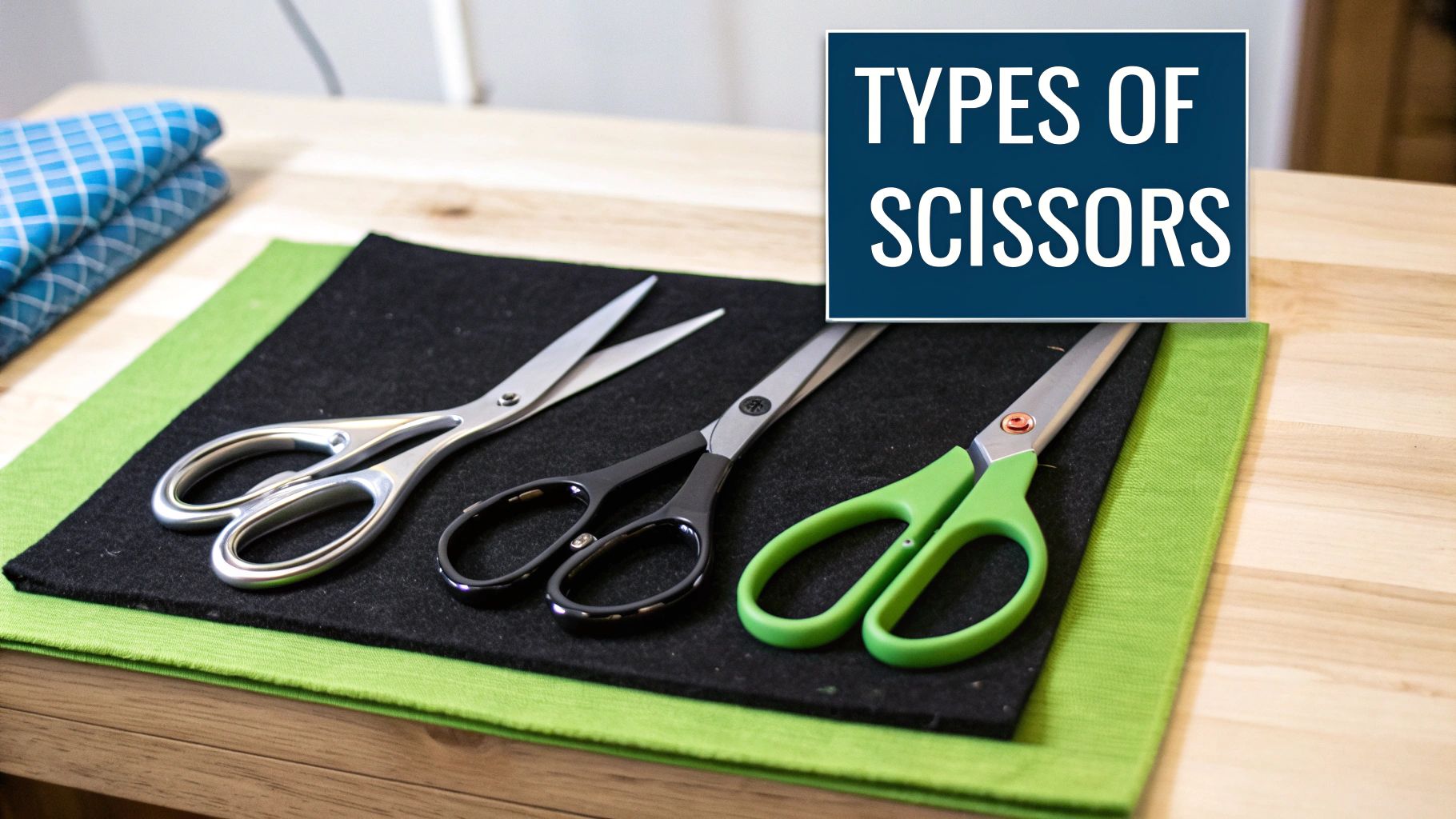
If you've ever tried to cut fabric with those all-purpose scissors from your kitchen drawer, you know the frustration. It’s a bit like trying to chop a tomato with a butter knife—you’ll get through it, but the result is a mangled, pulpy mess. The same thing happens to your fabric.
Standard household scissors are built for brute force. Their thick, beveled blades are designed to crush and tear through paper, cardboard, and plastic packaging. When you turn them on fabric, they don’t slice through the delicate fibers. Instead, they pinch and chew, leaving you with snagged threads, frayed edges, and pieces that are anything but precise. This small mistake can derail an entire project, leading to seams that won't line up and a final garment that just doesn't hang right. It’s a reminder that every tool has its purpose; specialized herb scissors, for example, are fantastic in the kitchen but would be just as damaging to your textiles.
The Science Of A Superior Cut
The best scissors for fabric, often called shears, are in a completely different league. They are precision instruments engineered with one job in mind: slicing cleanly through textiles. The secret lies in their blades.
- Blade Material: True fabric shears are forged from high-carbon steel. This metal is much harder than the typical stainless steel found in household scissors, meaning it can take—and hold—a much sharper edge for longer.
- Blade Edge: Instead of a chunky, beveled edge, shears feature a razor-fine "knife-edge." This steep, finely ground angle allows the blade to glide through fibers with almost no resistance. The result is a surgically clean cut, every single time.
This isn't just about making the process easier; it's fundamental to getting professional results. A good pair of shears is an investment that pays you back immediately in saved fabric, less frustration, and better-looking projects.
A dedicated pair of fabric scissors is the foundation of precision sewing. They don't just cut fabric; they preserve the integrity of the weave, ensuring every pattern piece is a perfect reflection of your design.
The demand for high-quality sewing tools is on the rise, and it’s easy to see why. As more people embrace DIY sewing and the global apparel industry expands, the market for professional tailoring scissors is booming. Valued at roughly USD 1.2 billion, the global market is projected to hit USD 1.8 billion by 2033. This growth shows just how much creators value having the right tools for the job.
So, what’s the takeaway? The first and most important rule in any sewing room is to have a dedicated pair of fabric-only shears and protect them with your life.
The Anatomy of a Perfect Pair of Fabric Scissors
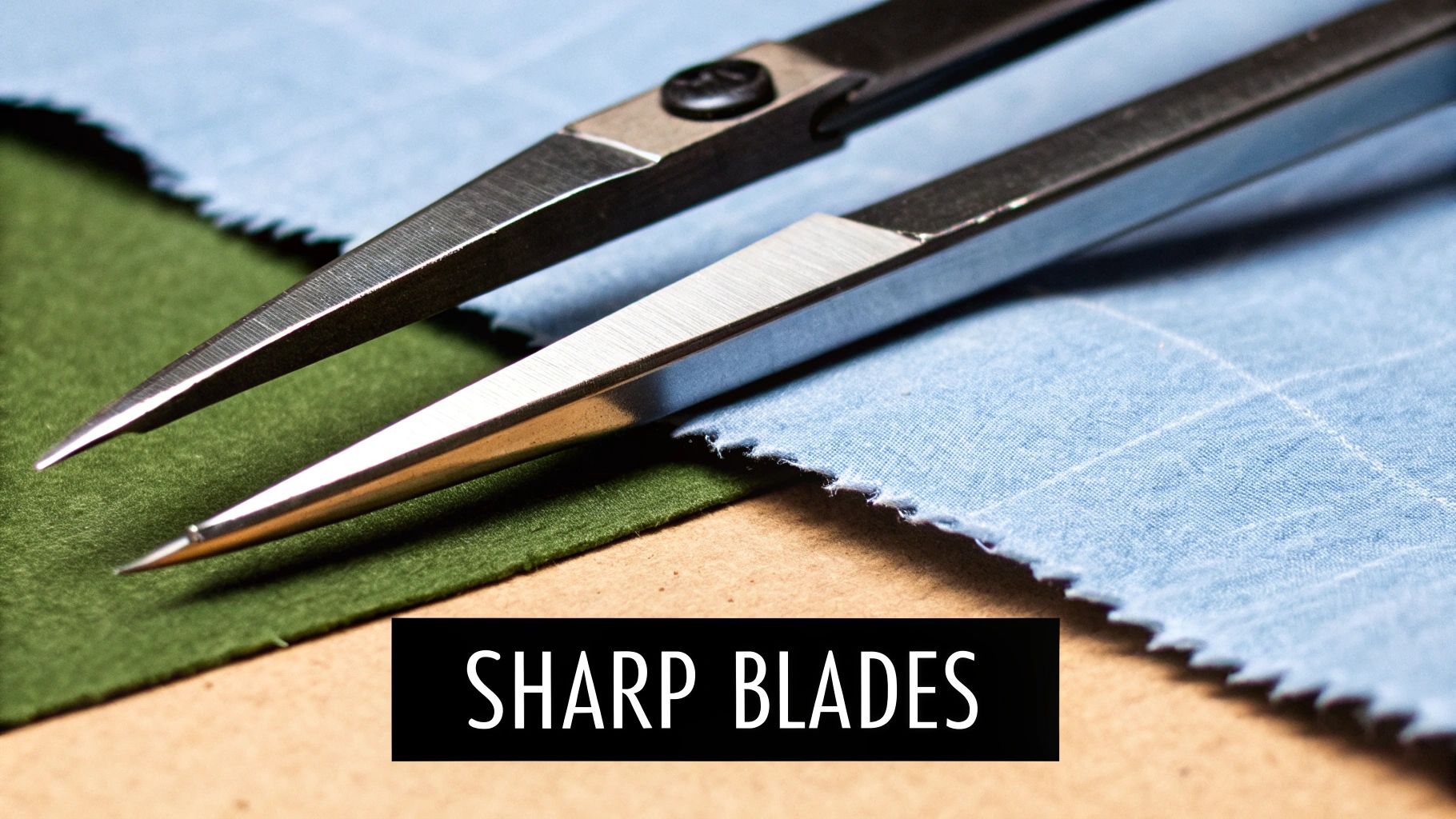
So, what’s the real difference between a truly great pair of fabric scissors and one that’s just… okay? It all comes down to the details. The materials, the engineering, and the smart design choices that turn a simple tool into something built for precision. Knowing what to look for is how you spot real quality and find the perfect scissors for the way you work.
Think of it this way: you can get from A to B in a family sedan or a finely tuned sports car. Both get the job done, but one gives you incredible performance, control, and a much smoother experience. A top-tier pair of fabric shears is engineered for performance, and that starts with the steel.
The Heart of the Shears: The Blades
The blades are where the magic happens. Their quality determines everything from how sharp they are to how long they’ll last. The best shears you can buy are almost always forged from high-carbon steel. This isn't your average stainless steel—it's a much harder, more resilient material.
That extra hardness is what allows the blades to be sharpened to a razor-fine edge that actually stays sharp. It’s why a good pair can slice through thick wool or multiple layers of cotton like butter, while a cheaper pair will snag, chew, and fight you the whole way. A well-made blade means you spend more time cutting and less time sharpening.
But it's not just the metal. The shape of the cutting edge itself is a huge deal.
- Knife-Edge Blades: This is what you'll find on the best shears. The blades are ground at a really steep angle, creating an edge that slices cleanly through fabric fibers instead of pinching them. This is what gives you that incredibly satisfying, smooth cutting feeling.
- Micro-Serrated Blades: These are a game-changer for slippery fabrics. One of the blades has tiny, almost invisible teeth that gently grip materials like silk or chiffon. This subtle grip keeps the fabric from sliding away from the blades as you cut.
Ergonomics and Handling
The sharpest blades in the world won’t do you any good if the scissors are a pain to hold. How the handle is designed has a massive impact on your control and comfort, especially when you’re cutting out a big project. The best scissors for fabric are built with the human hand in mind.
A well-designed pair of shears should feel like a natural extension of your hand. The handle's shape dictates how you transfer force to the blades, directly impacting your accuracy and comfort.
The most important ergonomic feature is the classic bent handle. This clever design lets the bottom blade lie completely flat on your cutting table, so the fabric doesn't lift or shift as you cut. Your hand stays comfortably up and out of the way, giving you a perfect line every time.
On the other hand, smaller snips and thread clippers usually have straight, symmetrical handles. This makes them quick and agile for little tasks, like trimming threads or snipping into tight corners where a big pair of shears just won't fit. Never underestimate the handle—it’s just as important as the blades.
Matching Your Scissors to Your Fabric and Project
Think of choosing fabric scissors like a chef picking their knives. You wouldn't use a massive cleaver to mince garlic, and you wouldn't use a tiny paring knife to carve a roast. The same idea applies here. Picking the right pair of scissors for the job is less about finding one "perfect" tool and more about having a few key players in your toolkit.
Get this right, and you'll get clean, effortless cuts that make the entire project go smoothly. Get it wrong? You risk snagging delicate fabrics, struggling through heavy ones, and ending up with a frayed, choppy mess. It’s one of those foundational skills that can make or break your final result.
Heavyweight Champions for Tough Fabrics
When you’re staring down a pile of denim, canvas, or thick wool, you need scissors with some real muscle. This is the domain of traditional tailor's shears.
- Denim and Canvas: The tight, dense weave of these fabrics demands a tool that won't flinch. A pair of heavy 8- to 10-inch shears gives you the leverage to power through in one long, clean cut, saving your hands from a world of hurt.
- Wool and Upholstery Fabric: Ever tried cutting multiple layers of a thick wool coating? The material can literally push weaker blades apart. The sheer heft and sharp, knife-edge of proper tailor's shears ensure they stay on track and slice right through.
Precision Tools for Delicate and Slippery Textiles
On the flip side, you have fabrics like silk and chiffon that seem to have a mind of their own. For these, brute force is your enemy; what you really need is control.
- Silk and Chiffon: These materials are notorious for slithering around your cutting table. The secret weapon here is a pair of micro-serrated scissors. One of the blades has tiny, invisible serrations that gently grip the fabric, preventing it from shifting as you cut. No more snags, no more wonky lines.
- Rayon and Satin: These fabrics are also a bit shifty, but less so than silk. A good pair of sharp, 8-inch dressmaker's shears with a fine, pointed tip gives you the perfect mix of length for straight cuts and precision for navigating curves.
Using the right scissors for your fabric isn't just a suggestion; it’s a form of insurance. It protects your expensive material from snags and frays while safeguarding your project's accuracy from the very first cut.
Specialized Scissors for Specific Tasks
Sometimes, a project throws a curveball that your standard shears just can't handle. That's when you reach for a specialist tool, designed to solve a very specific problem.
- Appliqué and Intricate Curves: For detailed appliqué work, you need appliqué scissors. They have a weird-looking paddle-shaped blade, often called a "duckbill," that rests flat against your base fabric. This design cleverly lifts the layer you're trimming while protecting the fabric underneath from accidental cuts.
- Quilting and Patchwork: When you're cutting out dozens of small, precise shapes, long shears feel clumsy. A smaller, nimble pair of 5- to 6-inch shears gives you the maneuverability to get around tight corners and templates with total accuracy.
- Finishing Seams: To stop woven fabrics from unraveling into a stringy mess, pinking shears are a classic solution. They cut a zig-zag pattern along the raw edge, which is a fast and easy way to finish the internal seams on garments made from cotton, linen, or flannel.
Matching the right tool to the right material is a game-changer. Here’s a quick guide to get you started.
Scissor vs Fabric A Practical Matchmaking Guide
| Fabric Type (e.g., Denim, Silk, Cotton) | Recommended Scissor Type | Reasoning |
|---|---|---|
| Denim, Canvas, Corduroy | 8"-10" Tailor's Shears | The long, heavy blades provide leverage to cut through thick, dense weaves without hand strain. |
| Silk, Chiffon, Organza | Micro-Serrated Scissors | The tiny serrations grip slippery fabric, preventing it from shifting and ensuring a clean, snag-free cut. |
| Cotton, Linen, Flannel | 8" Dressmaker's Shears | A versatile, all-purpose choice that is sharp and precise enough for medium-weight wovens. |
| Rayon, Satin, Crepe | 8" Dressmaker's Shears (very sharp) | The sharp, fine tip offers excellent control for fabrics that are shifty but not overly slippery. |
| Knit Fabrics (Jersey, Interlock) | 8" Ball Point Shears or Rotary Cutter | Ball point shears have a rounded tip to push knit fibers aside rather than cutting them, preventing runs. |
| Fleece, Minky, Faux Fur | 8"-10" Tailor's Shears | The power is needed to get through the bulk, and long blades minimize the number of "chomps" to create a smoother line. |
| Leather, Vinyl | Heavy-Duty Shears or Rotary Cutter | Requires exceptionally strong blades that won't be dulled or pushed apart by the tough, non-woven material. |
Ultimately, having a few different types of scissors on hand means you're always prepared, no matter what fabric your next project calls for.
This decision tree helps visualize how factors like hand size and usage frequency can guide your choice of handle and comfort features.
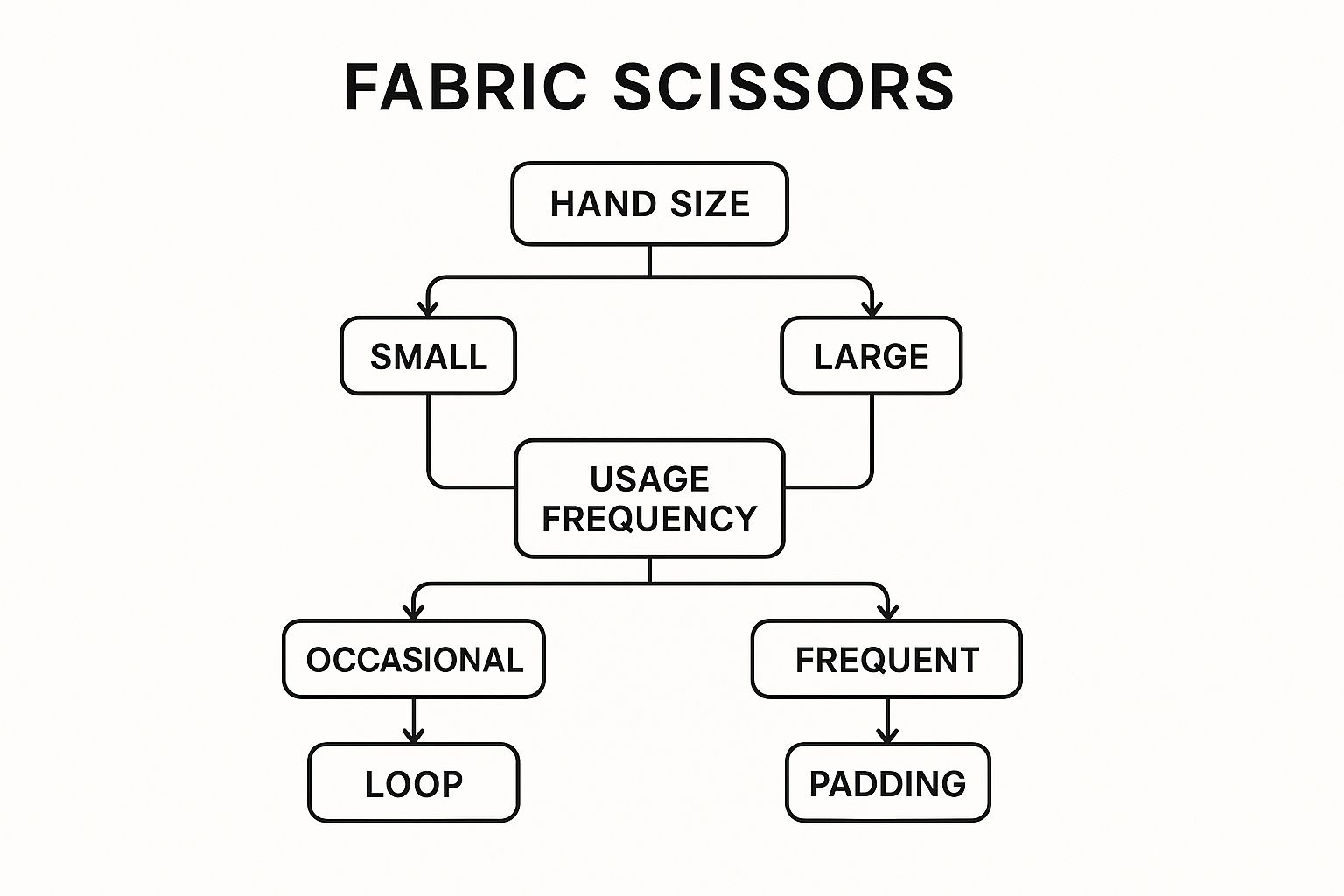
The infographic shows that ergonomics are just as critical as blade type, ensuring comfort and control during long cutting sessions.
Getting a Handle on Electric and Specialized Fabric Cutters
While a great pair of traditional shears is a must-have, sometimes you need a little more power on your side. Technology has given us some incredible tools that can be a real game-changer, especially when you're facing down a massive project or dealing with hand strain from conditions like arthritis.
https://www.youtube.com/embed/6yQp7WYP-E4
Think about it: a small, handheld cutter that buzzes through thick layers of fabric with a simple push of a button. That's the magic of electric scissors. They take all the squeezing and repetitive stress out of cutting, letting a tiny, self-sharpening blade do all the heavy lifting for you. For anyone who spends hours cutting, this can be a true lifesaver.
It’s no surprise that these tools are becoming more popular. The global market for electric fabric scissors is already valued at around $460 million and climbing. It seems everyone from home sewing enthusiasts to big-time manufacturers is looking for ways to make cutting easier and more efficient. You can explore more about this growing trend and how it’s shaking up the textile world.
The Rotary Cutter Revolution
Another indispensable tool, particularly beloved in the quilting community, is the rotary cutter. If you've never seen one, picture a pizza cutter designed for fabric. It's a simple concept—a circular blade on a handle—but its precision is absolutely incredible when run alongside a ruler.
- Perfectly Straight Edges: When you need long, flawless straight cuts for quilt strips or binding, nothing beats a rotary cutter. It completely gets rid of the tiny wobbles you can get with scissors.
- Cutting in Stacks: With a sharp blade and a good self-healing mat, you can slice through 4 to 6 layers of cotton at once. This ability to "batch cut" pieces is a massive time-saver for any project with lots of repeating shapes.
For a quilter, the rotary cutter is more than just a convenient tool—it's the key to the whole craft. Achieving that perfect geometric precision is what it's all about, and the rotary cutter makes it not just possible, but downright satisfying.
So, how do you choose? It really boils down to the job at hand. If you're tackling tricky curves or cutting through tough, bulky materials, electric scissors are your best friend. But for lightning-fast, laser-straight lines, the rotary cutter is the undisputed champion. Either way, both tools represent a huge step up, making the prep work of any sewing project faster, more accurate, and a whole lot easier on your hands.
Keeping Your Scissors Sharp for a Lifetime of Use
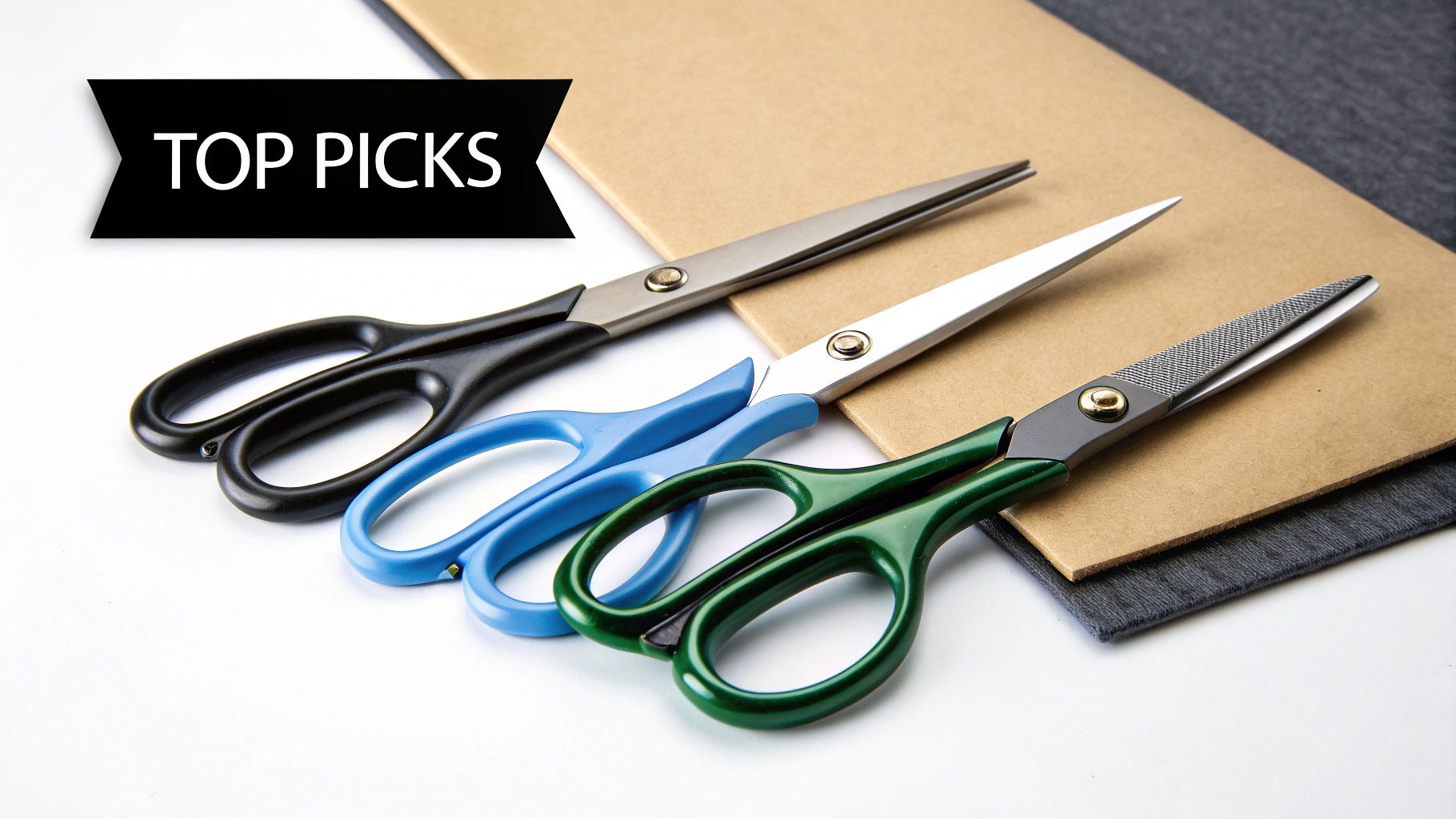
A great pair of fabric scissors isn't just a tool; it's an investment. With the right care, that investment should last for years, maybe even a lifetime. It’s a lot like how a chef treats their knives—a little bit of regular attention goes a long way.
Protecting your shears isn't difficult. It really just comes down to building a few good habits that will make a huge difference in how they perform and how long they last.
The most important habit is also the simplest: cleaning. After you finish a project, just take a moment to wipe the blades down with a soft, dry cloth. This gets rid of the tiny fibers and lint that love to collect around the pivot screw, which can make the action feel stiff or throw the blades out of alignment.
Essential Maintenance Rituals
Beyond a quick wipe-down, a little extra care will keep your shears in prime condition. These small steps are your best defense against wear and tear, making sure your cuts stay as clean and effortless as the day you first used them.
- Oil the Pivot: Every few months, put a single drop of sewing machine oil right on the pivot screw. Open and close the scissors a few times to work it into the joint, then wipe off any excess. This keeps the movement smooth and buttery while preventing rust.
- Store Them Safely: Whatever you do, don't just toss your good scissors in a drawer with other tools. That’s a surefire way to get nicks in the blades or, even worse, damage the tips. Keep them in a sheath, a fabric case, or a special spot on your pegboard where they won't get banged around.
If you remember only one thing, let it be this: Only cut fabric. Using your shears on paper, cardboard, or anything else will demolish that finely-honed edge. It turns a precision tool into a blunt, frustrating object in an instant.
To Sharpen at Home or Call a Pro?
No matter how well you care for them, all scissors will eventually need to be sharpened. You can find plenty of home sharpeners, but they rarely get the job done right. They just can't replicate the specific, precise angle needed for a true knife-edge.
For any pair of quality shears, I highly recommend finding a professional sharpening service.
Professionals have the specialized equipment to restore the exact bevel that allows the blades to slice through fibers instead of just crushing them. A bad sharpening job can ruin a pair of scissors for good. Think of it as a necessary tune-up every year or two—a small price to pay to keep your investment performing perfectly for decades.
Your Top Questions About Fabric Scissors, Answered
Even after covering the essentials, there are always a few lingering questions that come up when you're on the hunt for the perfect fabric scissors. Getting these sorted out can be the difference between a tool that lasts a lifetime and one that causes endless frustration. Let's tackle some of the most common ones.
Can I Sharpen My Fabric Scissors Myself?
You'll see plenty of DIY scissor sharpeners on the market, but for your high-quality fabric shears, I'd strongly recommend leaving it to a professional. The blades on good shears have a very specific, precision-ground angle called a knife-edge. This is what lets them slice through fabric fibers so effortlessly.
Home sharpeners, even the good ones, rarely get that angle just right. You risk creating an uneven edge or, worse, permanently damaging the blades. For a small fee every year or two, a professional will restore that perfect factory-sharp edge, keeping your investment in top shape for years to come.
Think of it like tuning a piano. You could try it yourself, but a professional has the specialized tools and experience to restore the instrument's performance perfectly. The same goes for your shears.
What’s the Real Difference Between Scissors and Shears?
While we often use the words interchangeably in casual conversation, there's a technical distinction that's actually pretty important in the sewing world.
- Shears are the heavy-lifters. They're typically longer than six inches and have those distinct asymmetrical handles. The larger loop fits several fingers, giving you more power and control for long, straight cuts through fabric.
- Scissors are smaller, usually under six inches, and have symmetrical, identical finger loops. They're designed for nimble, detailed work like snipping threads or trimming small appliqué pieces.
Why Are My Scissors Chewing Up the Fabric Instead of Cutting It?
Ah, the dreaded fabric "chewing." It’s incredibly frustrating, but it almost always comes down to one of three things.
First, check the pivot screw. If it’s too loose, the blades can separate just enough to fold the fabric between them instead of slicing it. A simple, gentle tightening with a screwdriver can often fix this in seconds.
If the tension is good, then your blades are probably dull. It’s time for that professional sharpening we talked about. Finally, the third culprit is misuse. If someone (maybe even you!) has used your precious fabric shears on paper, cardboard, or anything else, the fine cutting edge is likely nicked or damaged. This brings us back to the golden rule: your fabric scissors cut fabric only.
Ready to feel the difference a truly great pair of shears can make? Check out the premium selection of precision cutting tools at Famcut.com and find the perfect match for your sewing table. Visit us at https://famcut.com to level up your craft.